Envista Is Not a Spec: A Medical Supply Buyer’s Honest Take on Device Names
A medical supply buyer explains why ordering a surgical catheter, infusion pump, or cardiac monitor takes more than a product name.
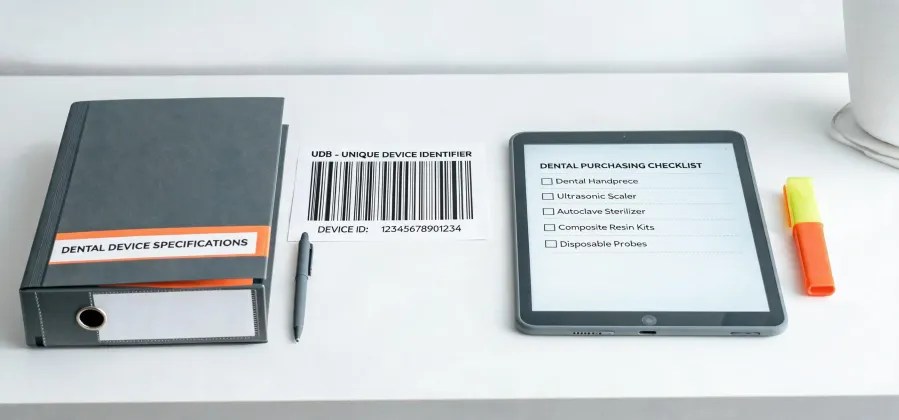
When I took over supply purchasing for an eight-site medical group in 2021, I thought the hard part would be negotiating prices to fit our capital budget. It wasn’t. The hard part was the gap between product names and product specifications.
A request for a “surgical catheter” can mean many different products. A request for an “infusion pump” can mean a large-volume pump, a syringe pump, a PCA pump, or an enteral pump. A request for a “cardiac monitor” doesn’t tell you if the patient is in an ICU, a telemetry unit, an operating room, or at home. I learned all of this the expensive way.
It wasn’t until a charge nurse asked me the question directly—“Do you know how a cardiac monitor works?”—that I realized I needed to change my whole process.
My first “surgical catheter” order should have been enough
Early on, a surgeon sent a request that said: “Need surgical catheter for tomorrow’s case.” I searched our approved supplier catalog under “surgical catheter,” found a few options, and picked one at a midrange price. It shipped quickly. The surgeon opened the box and said, “This isn’t even close.”
He needed a small catheter with a specific tip shape and intended use. The item I ordered was a drainage catheter. Both are technically “surgical catheters.” That’s the trap.
We use Envista as one of our approved manufacturers, so a colleague suggested I just search “Envista” in the catalog. That helped narrow the supplier, but it didn’t solve the real problem. There’s no single product called “Envista surgical catheter.” A brand name doesn’t replace an intended-use statement. It only becomes useful after I know what the clinician is trying to accomplish.
Infusion pumps: a category pretending to be a product
Months later, the neonatal transport team asked for three “infusion pumps.” I compared prices for standard large-volume IV pumps and requested a quote. The nurse manager stopped me before I submitted it.
They needed syringe pumps capable of delivering very low flow rates, with small footprints and battery operation for transport. A large-volume pump is a completely different device in that setting.
If you don’t buy medical equipment often, “infusion pump” sounds specific. It is not. It’s an umbrella term for several product families. If the request doesn’t say which type, I have to ask. And if I don’t ask, I’m guessing with someone’s capital budget.
The cardiac monitor question
The nursing lead on our procedure committee asked me to help replace six monitors. Then she asked, “Do you actually know how a cardiac monitor works?”
I gave her the basic explanation: a cardiac monitor detects the heart’s electrical signals through electrodes on the skin, amplifies and filters those signals, and displays the heart’s rhythm as an ECG waveform. It calculates heart rate and alerts staff to rhythms that need attention. Many models also measure oxygen saturation, blood pressure, respiration, or capnography.
That night I searched online for “how does a cardiac monitor work” to fill in my gaps. But the bigger procurement question was: which monitor belongs in which care area? A bedside monitor in a cardiology unit is not the same as a telemetry transmitter. A portable monitor for recovery is not the same as a multi-parameter monitor with invasive pressure channels. I needed to know where it would be used, who would watch the alarms, and whether it had to connect to our EMR.
Once I started asking those questions, the equipment choices stopped being guesses.
The root cause: I was treating clinical intent as a keyword search
Part of me wanted to blame my clinical colleagues for writing vague requests. But I was making the same mistake. They think in patients, procedures, and care settings. The purchase order system thinks in category names. A clinician says “surgical catheter” because that’s how they learned it. A catalog says “surgical catheter” because that’s how the product family is filed. Those two labels don’t always match.
I do not mean clinicians are being careless. Most of them have all the important context in their heads. They just don’t know which details I need on the purchasing side. It’s my job to ask.
I don’t have hard data on industry-wide ordering errors from this kind of ambiguity. What I can say anecdotally is that in our own records from 2024, roughly a third of device requests required at least one clarification before I could order confidently. In a year with 60–80 device orders, that inconsistency adds up.
What these mistakes actually cost
The obvious cost is time. A wrong order means contacting the vendor, arranging a return, re-entering a purchase request, and explaining the delay. A single mismatch can eat two or three hours of administrative work.
The harder cost is financial. We once ordered a specialized external catheter for a procedure that had to be delayed because the supply didn’t match the patient’s anatomy. We paid restocking fees and freight. I remember one invoice where the line item said “catheter,” but the device family wasn’t right for the case. Finance rejected it, and I had to sort out a corrected invoice. That’s exactly the kind of administrative mess that makes purchasing look inefficient.
The most important cost is trust. When a clinical team asks why a monitor can’t connect to the hospital network or why a pump doesn’t fit a transport cart, they don’t want to hear that the purchase was based on a generic label. They want to know that the person who spent the money understood the clinical setting.
A better workflow without pretending to be a clinician
The change that helped most was small. Every non-routine device request now has to include a one-line intended use statement. Not a brand and not a category. The clinician writes what the device has to do, where it will be used, and who will use it.
If the request says “surgical catheter,” I ask: What anatomy? What is it being used for? Is there a size range or an existing product being replaced? If it says “infusion pump,” I ask: Large-volume, syringe, PCA, enteral, or ambulatory? If it says “cardiac monitor,” I ask: Which care area? Does it need telemetry, central station visibility, EMR integration, or portable use?
I also ask suppliers for the intended-use statement from the device labeling, not just the trade name. Then I compare that statement against the clinical need. If I can match those, then looking at an approved portfolio like Envista makes sense. If I can’t match them, I don’t force the purchase just because a product appears in the same category.
Finally, I bring clinical engineering or IT into the discussion before the first quote, not after the purchase. They know about power supplies, network integration, mounts, servicing, and consumables. Their questions have prevented more bad decisions than any price benchmark I’ve used.
This sounds obvious in hindsight. Looking back, I should have made the intended-use form mandatory from day one. At the time, I didn’t want to create more steps for busy clinicians. But asking one focused question at the beginning is much easier than untangling a wrong device order later.
No process will eliminate every error. But I stopped treating “surgical catheter,” “infusion pump,” or “cardiac monitor” as if those words were enough. They are starting points. The actual spec lives in the clinical need behind the request.

Elena Varga
Elena Varga is a medical imaging systems analyst covering CT scanners, MRI systems, ultrasound platforms, digital radiography, mammography, and ophthalmic imaging equipment. She references IEC 60601-2-44 for CT safety and essential performance while examining CTDIvol, dose-length product, spatial resolution, slice thickness, field uniformity, throughput, uptime, and DICOM interoperability. Her work helps radiology leaders, medical physicists, biomedical engineers, and procurement teams compare image quality, radiation management, workflow integration, serviceability, and lifecycle cost.