How to Vet Medical Equipment Vendors: A 7-Step Checklist for Clinic Administrators
A practical checklist for administrators evaluating medical device suppliers. Covers invoice verification, compliance anchoring, and the one step most buyers skip.
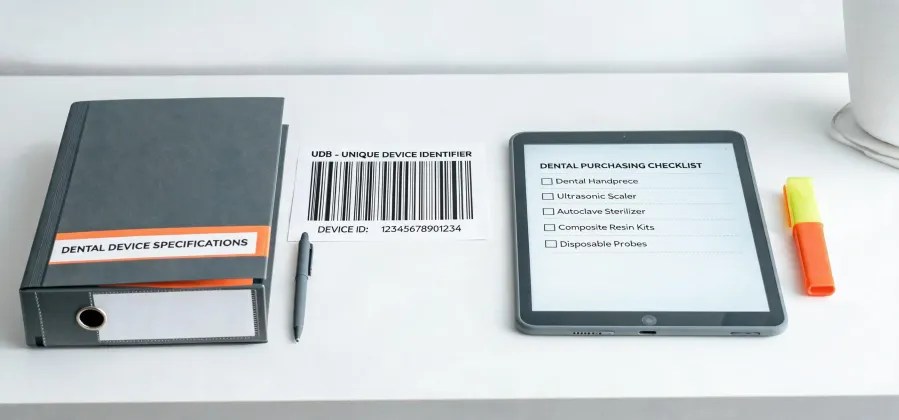
About three years ago—I want to say mid-2022—I almost signed off on what looked like a great deal for a floor-model dental autoclave. The pricing was about 18% under the other quotes we had. The sales rep was responsive. The delivery window lined up with our clinic expansion. Everything looked good.
Then I asked for a sample invoice. The vendor sent a handwritten receipt. Not a joke. Handwritten.
Finance rejected the reimbursement. My operations director asked me why I'd waste time on vendors who can't do basic invoicing. I had to go back to the original quotes and start over. The vendor I was trying to replace ended up staying on for another six months.
I learned a lesson that cost me about $2,400 in departmental budget waste and maybe—maybe—two aspirin per week. So I built a checklist. If you're managing procurement for a dental clinic, a diagnostic lab, or a surgical center, this is what I use now. It takes about an hour the first time. The second time, it takes 20 minutes.
Before You Start: Who This Is For
This checklist is for administrators who manage routine medical equipment orders—dental chairs, imaging peripherals, clinical analyzers. Things in the $5,000 to $50,000 range. If you're buying an MRI machine (which, for context, runs $1–3M depending on the field strength and whether it's refurbished), you need a different process entirely. This is not that checklist.
Also: this assumes you're dealing with a new vendor. If you're renewing with an existing supplier, the process is different because you already have data on their performance. Skip to Step 3 in that case.
Step 1: Verify Their Invoicing Capability (The One Everyone Misses)
I don't care if the equipment looks good. I don't care if the price is competitive. If the vendor cannot produce a compliant invoice, the deal is dead. It's the single most overlooked step, and it's the one that will cost you real money.
Here's what to verify before you even discuss price:
- Do they issue electronic invoices (PDF or EDI)? Handwritten or simple Word docs are red flags.
- Does the invoice include the required line items? Your finance department likely needs: purchase order number, item description, unit price, quantity, tax breakdown, vendor tax ID, and remittance address.
- Can they invoice in your preferred currency? If you're in the US and they quote USD but invoice in a different currency, that's a hidden risk.
Real example: In early 2024, a vendor quoted me a great price on a digital X-ray sensor. When I asked for a sample invoice, it listed the item as 'Sensor S/P SM'—no serial number, no model number, no description. Finance kicked it back. I asked the vendor to fix it. They couldn't. That deal was dead in two days.
Step 2: Check Their Compliance Anchor
Medical equipment isn't like office furniture. There are regulatory requirements. For most equipment in a clinic setting, you need at least:
- FDA registration (or equivalent for your market—CE marking for Europe, TGA for Australia, etc.)
- ISO 13485 certification for the manufacturer
- Service documentation for routine maintenance and calibration
Don't take their word for it. Ask for the registration number and verify it with the relevant agency. The FDA's Establishment Registration & Device Listing database is public. It takes five minutes to check.
I once had a vendor claim they were FDA-registered. A quick search showed their registration had expired three months prior. They apologized and said they'd 'renew soon.' I moved on.
Step 3: Confirm Delivery Terms in Writing
This sounds basic. It's not. I've seen delivery windows slip by weeks because the terms were vague. Here's what you need in writing:
- Incoterms (for international orders) or shipping terms (for domestic): FOB origin vs. delivered. If it's FOB origin, you own the risk once it leaves their dock.
- Lead time: Not '2-3 weeks.' 'Delivered to our loading dock by [specific date], pending credit approval.'
- Shipping carrier and class: They can't just say 'we'll ship it.' You need the carrier name and the service level.
I process about 60–80 orders annually across 8 vendors. The ones who are specific about delivery are the ones who deliver on time. The ones who say 'we'll get it to you'—those are the ones I track with delivery confirmation and still get surprised.
Step 4: Evaluate Their Service Network
Equipment breaks. When it does, you need someone who can fix it. Ask:
- Do they have in-house technicians, or do they subcontract? Subcontractors are fine, but you need to know their response time and availability.
- What's their typical response time for non-emergency service? 24–48 hours is standard. More than 72 hours is a problem.
- Do they have loaner equipment available? For critical devices like autoclaves or analyzers, this matters. A broken autoclave means you cancel procedures.
I learned this the hard way. In 2023, our primary lab analyzer went down. The vendor's nearest service tech was three hours away and had a 2-day backlog. We lost a day of testing. That vendor is no longer our primary.
Step 5: Get References—and Call Them
Every vendor has references. Not every reference is useful. Here's how I vet them:
- Ask for three references—one recent (within the past year), one from a facility of similar size to yours, and one that's been using the equipment for at least 18 months.
- Ask specific questions: 'How many times has the equipment needed service in the first year?' 'How responsive was the vendor to warranty claims?' 'Would you buy from them again?'
- Don't just talk to the person who bought it. Ask to speak to someone in biomed or facility maintenance—the person who actually fixes the thing. They'll give you the unvarnished truth.
I've had references gush about a vendor, only to find out from the maintenance team that the device is a nightmare to service. Those conversations are gold.
Step 6: Calculate Total Cost of Ownership (TCO)—Not Just Purchase Price
The upfront price is only part of the story. A cheap device that costs a lot to maintain isn't cheap. Here's what to include in your TCO calculation:
- Consumables and supplies: Some devices use proprietary supplies that are expensive. Ask for the cost of consumables for the first year.
- Service contracts: Are they required? How much do they cost? What's covered?
- Training: Do they charge for initial training? Ongoing training?
- Software updates: Are they included? For imaging or diagnostic devices, software updates can be significant.
As of January 2025, a service contract on a mid-range digital imaging system runs about 8–12% of the purchase price per year. If a vendor quotes $40,000 for the system and tells you the service contract is $5,000/year, that's on the high side. If they say $2,000/year, that's more typical.
Step 7: Have an Exit Strategy
This is the step most people skip. Before you sign anything, know how you'll get out. Specifically:
- What's the contract term? Annual renewal? Multi-year? Auto-renewal?
- What are the termination fees? Some vendors charge a penalty for early termination. Know the amount.
- Can you back up your data? For software-based devices (PACS, practice management, lab information systems), you need to know how to extract your data when you leave.
- What happens if the vendor goes out of business? I know this sounds paranoid, but in 2024, I had a vendor—a small dental supply distributor—simply close. They didn't even send a notice. I had to scramble to find a replacement.
A Few Things to Watch For
I've been doing this for a while, so here are a couple patterns I've noticed:
- The 'too good to be true' price. If a quote is 30%+ below the next closest competitor, there's usually a catch—lower quality, no service, poor warranty, or a company that's struggling.
- Vendors who rush you. 'This price is only good for 24 hours.' That's a negotiation tactic, and it often indicates they know the price is aggressive and are trying to get you to commit before you think it through.
- Vague warranty terms. 'We stand behind our products' is not a warranty. Look for specific terms—parts and labor for X years, what's excluded, and how claims are processed.
This checklist isn't magic. It's just a way to systematically eliminate bad options before they cost you time and money. I use it for every new vendor evaluation now. It's saved me more headaches than I can count.

Elena Varga
Elena Varga is a medical imaging systems analyst covering CT scanners, MRI systems, ultrasound platforms, digital radiography, mammography, and ophthalmic imaging equipment. She references IEC 60601-2-44 for CT safety and essential performance while examining CTDIvol, dose-length product, spatial resolution, slice thickness, field uniformity, throughput, uptime, and DICOM interoperability. Her work helps radiology leaders, medical physicists, biomedical engineers, and procurement teams compare image quality, radiation management, workflow integration, serviceability, and lifecycle cost.