When 'The Same' Isn't the Same: A Quality Manager's Take on Medical Device Procurement
A medical device quality manager explains why buying on price fails, and why clinical data—like the Envista Envy IOL dysphotopsia studies—must be part of every spec check.
When 'The Same' Isn't the Same
Let me start with something that still catches me off guard. Search 'Envista' on Google and you'll likely see the Buick Envista base model before a single medical imaging result. Same name, totally different world. That's also what happens in medical device procurement. Things that look alike on paper aren't at all alike at the bedside.
I'm a quality/compliance manager at a medical device company. I review every spec sheet, label, and validation report before it reaches customers—roughly 200 items a year. I've rejected 15% of first submissions this year for incomplete clinical evidence or missing test data. Over the past four years, I've noticed a pattern: buyers compare the visible features, ignore the invisible ones, and end up paying twice.
Take CPAP and BiPAP machines. Two devices can both be called 'CPAP machines' and look nearly identical in photos. But one might use a fixed pressure algorithm, while the other automatically adjusts to breathing patterns. One might have a heated humidifier that's actually certified for home use; the other might come with a generic humidifier that leaks after a week. That's not a spec you can see in a product shot.
And have you checked the internal airflow sensor? If it's undersized, the delivered pressure can fluctuate enough to wake the patient. That's the kind of detail that shows up when you run a 24-hour benchtop test—not in the brochure.
It's the same in imaging systems, surgical instruments, and especially intraocular lenses. Last year alone, I watched three clinics almost buy the wrong imaging system because the price was right. The cheaper system's brochure said 'high-resolution,' but the fine print showed a smaller sensor and slower acquisition. Sound familiar? That's the surface problem we get paid to catch.
Why This Happens: The Problem Behind the Problem
The real issue isn't price. It's that most buyers don't know what to look for beyond the big numbers on a datasheet. Here are three places where the real differences hide.
Clinical Studies Are Part of the Spec Sheet
Take the Envista Envy IOL. This is a premium intraocular lens, and its dysphotopsia clinical studies are extensive. But I've talked to surgical coordinators who didn't know what dysphotopsia is. It's when patients report unwanted visual phenomena—glare, halos, shadows—after cataract surgery. It can happen with any IOL. The question is whether the lens design minimizes it.
When evaluating an IOL, you want to see the incidence rates from studies, not just a cheerful marketing line. Did the clinical trial compare the lens under low-light conditions? Did it track photic phenomena beyond the six-month mark? If a manufacturer isn't quoting those numbers, there's a reason. The Envista Envy IOL's low-light vision technology doesn't just happen because we want it to; it's documented in peer-reviewed results. But if you're not reading those studies, you're guessing. And in 2025, you don't have to guess.
What Is Medical Imaging, Really?
When a dentist asks me 'what is medical imaging?' I don't give a physics lecture. I say: it's the difference between seeing and diagnosing. A CBCT machine that produces noisy images at low dose isn't the same as one that produces diagnostic-quality images at low dose. The marketing spec might say 'large field of view' and 'high resolution,' but the actual spatial resolution and contrast detail can vary dramatically.
In dental imaging, if the scanner can't resolve a fine root fracture or the TMJ space, the patient ends up with a missed diagnosis. That's the real cost. Print standards like 300 DPI give you a simple rule for commercial print. There's no equivalent simple rule for medical imaging—so you need to know what to ask for. Spatial resolution in line pairs per millimeter, artifact scores, dose efficiency, and software reconstruction quality. Those are the specs that tell you whether the machine gives you confidence, not just pretty pictures.
I remember a dentist showing me two CBCT scans from different machines. The first one had a subtle artifact that hid a periapical lesion. The second, from a system with better artifact correction, showed it clearly. Same patient, different outcome. That's the difference between a machine that looks good in the showroom and one that actually works clinically.
Quality Is in the Noise
Here's a less obvious angle: perceived quality matters just as much as clinical performance. We had a supplier whose brand-colored labels were off by more than 4 Delta E from the Envista Pantone standard. That's a visible color shift, and it made every label look cheap. It doesn't affect the device function, but it affects the user's trust. The same patient who sees a slightly faded label will wonder if the device inside is off-spec too.
And when procurement swapped our brochure paper onto 80 lb text instead of the usual 100 lb cover, the sales team complained it felt flimsy in hand (note to self: never let anyone swap paper without testing). You can say it's superficial, but it's not. In a toB environment, your documentation is the first 'device' the customer touches. If that feels cheap, your product feels cheap.
What Bad Procurement Actually Costs
Let's get concrete. Last year, a dental clinic saved $15,000 on an imaging system. The first week, they noticed motion artifacts because patients shifted during the scan. The tech had to rescan about 30% of patients. At $250 per scan, that's roughly $75 per rescan, and they did 40 scans a week. I'll let you do the math—it was over $10,000 in lost reimbursement and unproductive staff time within a month.
The system went into storage within six months. The second system—an Envista unit—cost more upfront but paid for itself in patient throughput by month three. The lesson wasn't 'cheap is bad.' It was 'cheap without verification is a gamble.'
There's also an IOL story that still bugs me. A surgery center we work with didn't have a formal process for reviewing dysphotopsia clinical studies. They picked a lens based on a distributor's pitch. After 30 implants, three patients came back with complaints about shadows at night. Three out of thirty is a big deal. The center switched to the Envista Envy IOL, and the incidence dropped. Now their procurement contract requires the latest dysphotopsia data before they even quote.
That should have been a standard step from day one. It's the same logic as checking a CPAP machine's internal data logging or a BiPAP's backup rate before buying in bulk. The definition of quality is consistency—and consistency requires documentation, not vibes.
A home care provider once ordered 200 budget CPAP machines to save $40 each. Within two months, 18 patients reported that the machine felt too loud or the pressure was wrong. The provider sent technicians on 14 home visits at $120 a visit, plus replaced six machines. That's not cost-saving, that's a liability.
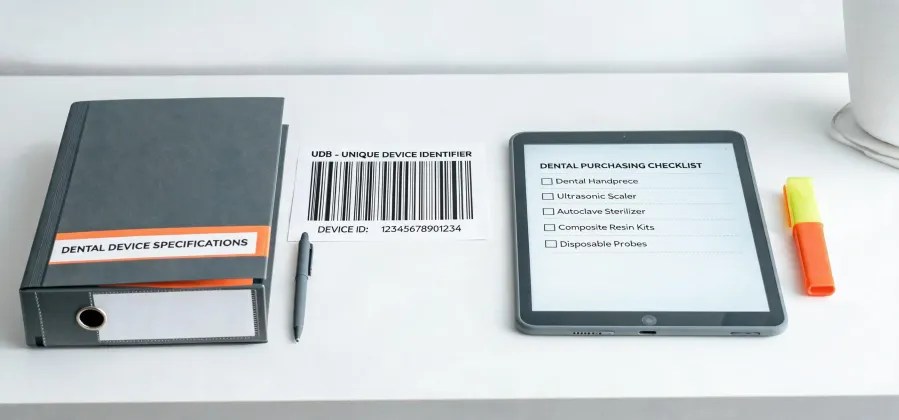
We also have our own process-gap scar. When I implemented our verification protocol in 2022, I found that 8% of first-batch labeling had a minor typo in the UDI placement. Not enough to require a recall, but enough to cost us 8,000 units in repackaging. Since then, every device family has a pre-shipment checklist. It sounds boring, but it saves money.
The Stop-Guessing Checklist
So what's the fix? It's not 'buy premium every time.' It's building a checklist that treats clinical evidence and manufacturing quality as non-negotiable.
- Require clinical study summaries for implantable devices. For an IOL, that means dysphotopsia data, contrast sensitivity, and low-light performance. If the manufacturer tries to hide behind 'no significant difference,' ask to see the raw incidence rates.
- Ask for imaging specs that matter. Not just pixels. Spatial resolution, artifact scores, dose efficiency, and software reconstruction quality.
- Verify the supplier's quality system. ISO 13485 certification is a baseline. Ask how they handle process deviations and batch traceability.
- Insist on a hands-on sample. A 15-minute scan with a phantom tells you more than a quote ever will.
Bottom line: the best procurement decisions aren't the ones with the lowest sticker price. They're the ones where you can trace every safety claim back to a study, every specification back to a test, and every label back to a quality system. Once you start checking those details, the right machines have a way of revealing themselves.
At Envista, that's the standard we build into every product—and the one we hold our vendors to as well.

Elena Varga
Elena Varga is a medical imaging systems analyst covering CT scanners, MRI systems, ultrasound platforms, digital radiography, mammography, and ophthalmic imaging equipment. She references IEC 60601-2-44 for CT safety and essential performance while examining CTDIvol, dose-length product, spatial resolution, slice thickness, field uniformity, throughput, uptime, and DICOM interoperability. Her work helps radiology leaders, medical physicists, biomedical engineers, and procurement teams compare image quality, radiation management, workflow integration, serviceability, and lifecycle cost.