Dental Equipment Buying Guide for Admin Buyers: Implant Components, Autoclaves, Chairs, and Surgical Kits
An admin buyer's no-nonsense checklist for sourcing implant components, dental surgery equipment, dental implant instruments, autoclaves, dental chairs, and surgical kits—verify traceability and service before price.
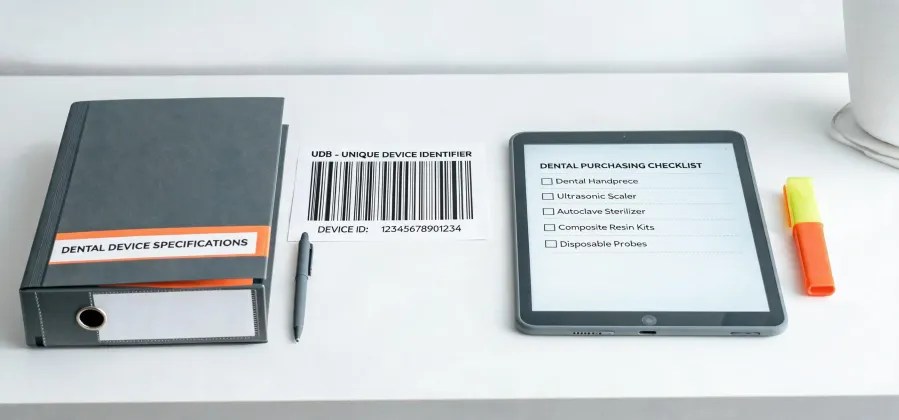
The short answer: verify the boring stuff first
If you are sourcing implant components, dental surgery equipment, dental implant instruments, an autoclave for sale, a dental chair for sale, or a dental surgical kit, do not start with the quote. Start with three checks: traceability, documentation, and service. I budget 10 to 15% above the sticker price for validation, installation, and training. That is the number that saves you from a cheap order turning into an expensive mess.
Here is the thing: the lowest bid usually wins the spreadsheet. It rarely wins the operatory. A missing lot number, a handwritten receipt, or a service tech who is four states away can wipe out the savings in one afternoon.
Why you should trust this checklist
I am an office administrator for a 60-person dental group. I manage all clinical and office ordering, about $1.2M annually across 9 vendors. I report to both operations and finance. When I took over purchasing in 2020, I thought buying dental equipment was like buying office chairs. It is not. Clinical equipment has paperwork, validation, and downtime costs that never show up in the catalog.
In 2022, I found a great price on surgical kits from a new vendor, about 22% cheaper than our regular supplier. Ordered 40 kits. They could not provide proper lot traceability or a valid invoice, just a handwritten receipt. Finance rejected the expense report. I ate $2,400 out of the department budget. Now I verify invoicing and traceability before placing any order. A lesson learned the hard way.
In our 2024 vendor consolidation project, I had to clean up ordering for 3 locations. Using a standard checklist cut our approval time from 9 days to 4. Not glamorous. But it worked.
What actually matters for each purchase
Implant components and dental implant instruments
Most buyers focus on per-unit pricing and completely miss lot traceability, sterilization instructions, and compatibility. The question everyone asks is, what is your best price? The question they should ask is, can you show me the UDI, lot number, and IFU for this exact item? I use single quotes in my PO notes for a reason: it forces the vendor to match the exact SKU, not a similar one.
For implant components, you need material certs (Ti-6Al-4V, for example), sterile packaging validation, and expiry dates. If a supplier cannot produce those in 24 hours, that is a red flag. In my opinion, the extra $8 to $15 per component is worth it if it keeps your implant log clean. Dental implant instruments are the same story. A torque wrench with no calibration certificate is a liability, not a bargain.
Dental surgical kits
I went back and forth between a cheaper generic dental surgical kit and a branded one for two weeks. The generic offered 25% savings. The branded kit had a known tray layout and replacement parts. Ultimately chose the branded one because the surgery schedule was too important to risk. The upside was $2,100. The risk was a missing retractor during a graft case. That math was not close.
Check instrument count, material, cassette compatibility, and whether you can buy single replacements. A kit is not a one-time buy. It is a relationship. If the vendor cannot sell you one replacement scissors without a six-week lead time, you will hate that kit within a quarter.
Autoclave for sale
For an autoclave, chamber size and cycle time are the obvious specs. The overlooked stuff is water quality, validation, and local service. I have never fully understood why some vendors consistently beat their quoted installation timelines while others miss. My best guess is internal buffer practices. So I ask for a written install window and a penalty clause now.
Ask about door seal life, preventive maintenance cost, and who repairs it when it dies on a Tuesday morning. If the autoclave for sale listing does not include installation and validation, add 15 to 25% to your budget. Also confirm the electrical and plumbing requirements before you sign. I have seen a clinic buy a floor model that needed a dedicated 208V line nobody had quoted.
Dental chair for sale
A dental chair is a logistics purchase as much as a clinical one. Measure the delivery path. Check floor load, power, air, and drain requirements. Confirm upholstery repair kits and lead times. I once saw a great deal on chairs that could not fit through the practice service corridor. Not ideal. But workable, after a $3,000 rigging bill.
Also ask about handpiece compatibility and control placement. Your hygienists will care more about that than the brochure color options. And if the dental chair for sale price seems too low, ask whether the delivery, install, and old chair removal are included. They usually are not.
Supplier questions I ask before any PO
- Can you send UDI, CE, or FDA documentation and IFUs for the exact SKU?
- What is the lead time in writing, and what happens if it slips?
- Who services this equipment locally? What is the response time?
- Can you invoice against a PO with net terms? Any fees?
- What is the return policy for unopened versus opened sterile items?
Per FTC guidelines (ftc.gov), advertising claims must be truthful, not misleading, and substantiated. Source: FTC Business Guidance on Advertising. That matters for dental surgery equipment. If a vendor says best-in-class or guaranteed compatibility, ask for the evidence. If they cannot show it, treat it as marketing.
When the cheapest option is fine, and when it is not
To be fair, not every purchase needs the premium tier. For non-sterile office equipment or backup instruments, budget options can work. I get why people go with the cheapest option, budgets are real. But for implant components, surgical kits, and autoclaves, the hidden costs add up fast.
Refurbished autoclaves and chairs can be smart if you get a warranty and local service. Lease versus buy? I am not sure there is one right answer. It depends on your cash flow and how long you will keep the room. My rule: if the equipment touches an implant or a sterile field, prioritize traceability and service over price.
Another boundary: if your clinic is in a remote area with no local service tech, a low-cost autoclave for sale can become a very expensive paperweight. In that case, pay for the brand with the strongest regional coverage. The same goes for dental implant instruments that need calibration or repair.
Bottom line
An informed buyer asks better questions and makes faster decisions. Before you compare an autoclave for sale, a dental chair for sale, implant components, dental surgery equipment, dental implant instruments, or a dental surgical kit, get the documents. Then talk price. If you are building out a full operatory, Envista has a broad portfolio across imaging, instruments, and more, but the same checklist applies. No vendor gets a pass on traceability, service, or paperwork.
Not glamorous. But it keeps finance, operations, and your clinical team off your back. And that is worth more than a 10% discount.

Elena Varga
Elena Varga is a medical imaging systems analyst covering CT scanners, MRI systems, ultrasound platforms, digital radiography, mammography, and ophthalmic imaging equipment. She references IEC 60601-2-44 for CT safety and essential performance while examining CTDIvol, dose-length product, spatial resolution, slice thickness, field uniformity, throughput, uptime, and DICOM interoperability. Her work helps radiology leaders, medical physicists, biomedical engineers, and procurement teams compare image quality, radiation management, workflow integration, serviceability, and lifecycle cost.